Rusty Metal Looks Out of Place in a Backyard: These Steel Rings Make You Look Twice

Would you put rusted metal in your backyard on purpose? These thick steel rings show why the answer might change once you see them lined up, with flowers growing through their openings and pale gravel running beneath them.
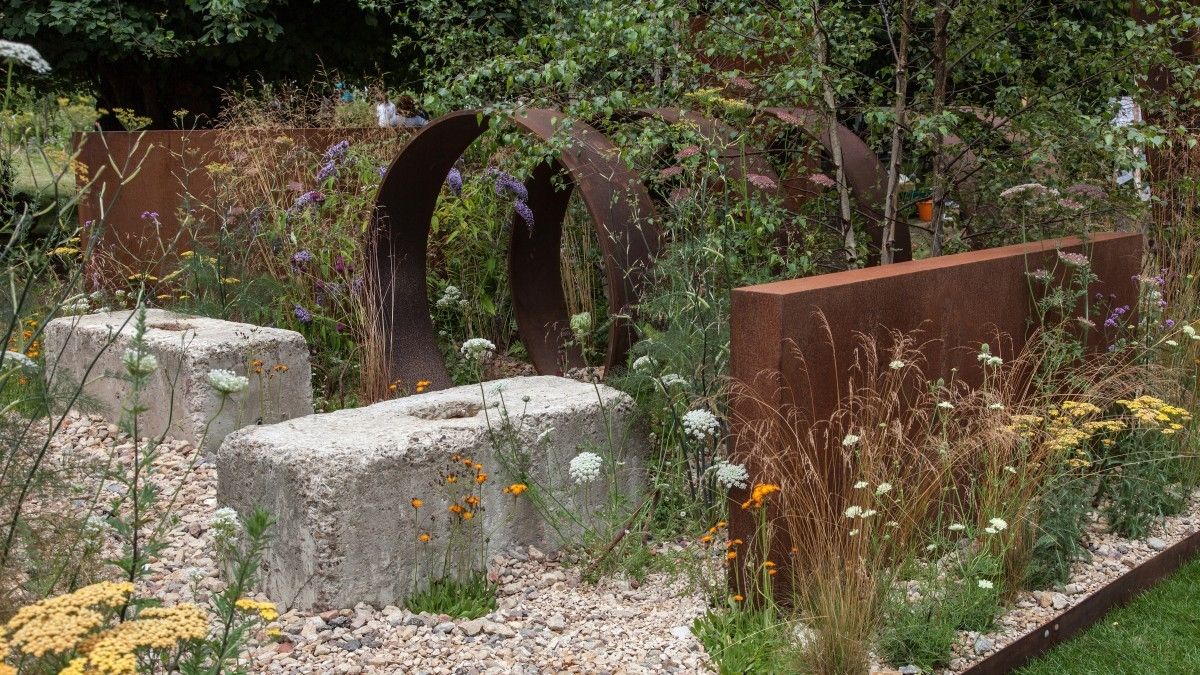
From the front, each circle frames the next, pulling your eye toward the planting at the far end. From the side, that tunnel disappears into separate curved bands, so the same feature gives you two distinct views.
Rust-colored panels behind fine grasses make their stems stand out, while tall folded sections rise between small trees. Metal supplies the shapes that catch your attention; orange, yellow, purple, and white flowers fill the spaces between them.
Steel Rings Create a Passage for the Eye
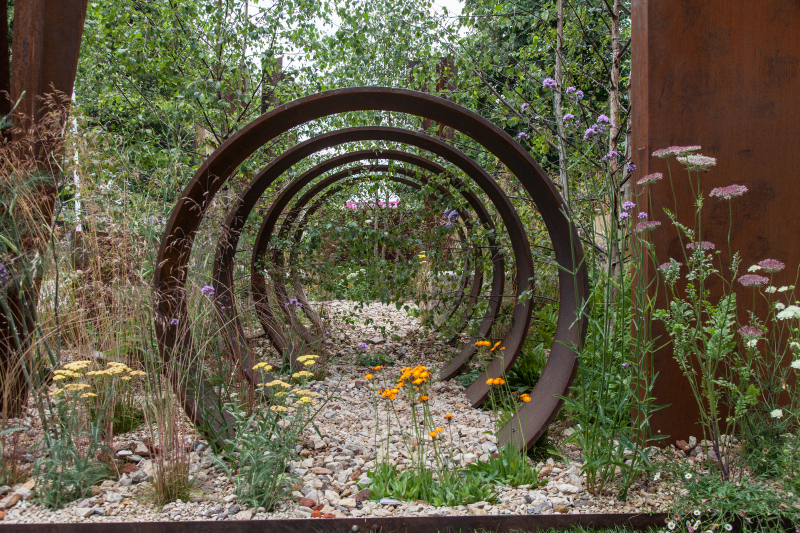
Successive circles frame the gravel and greenery beyond, with each opening appearing smaller as it recedes. Their lower edges disappear into the planting, so the sequence reads as part of the ground rather than a sculpture placed on a pedestal.
Orange flowers mark the foreground, while taller purple stems cross the openings. Those interruptions keep the view from becoming an empty tunnel, giving the eye several distances to move through within one narrow space.
A Side View Breaks the Tunnel Into Separate Bands
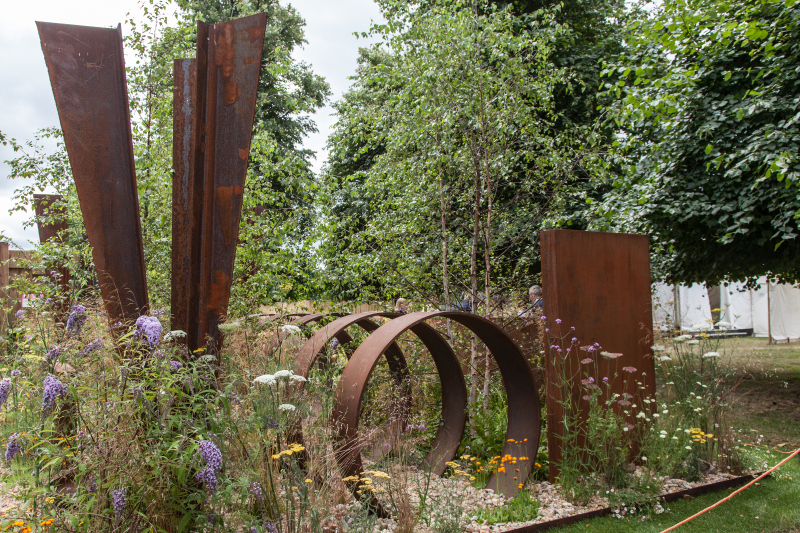
From an angle, the aligned openings separate into overlapping curves. Broad metal surfaces become visible along the sides, exposing the depth that the front view compresses into concentric outlines.
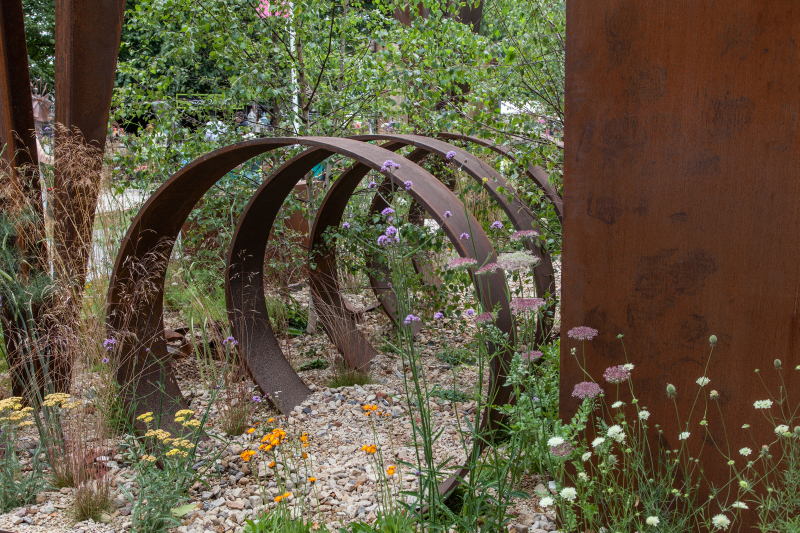
A tall rectangular panel stands beside the rings, adding a solid shape next to their open centers. Flowers occupy the gaps between both forms, with gravel continuing beneath them instead of dividing the sculpture from the planting.
Upright Metal Adds Height Between the Trees
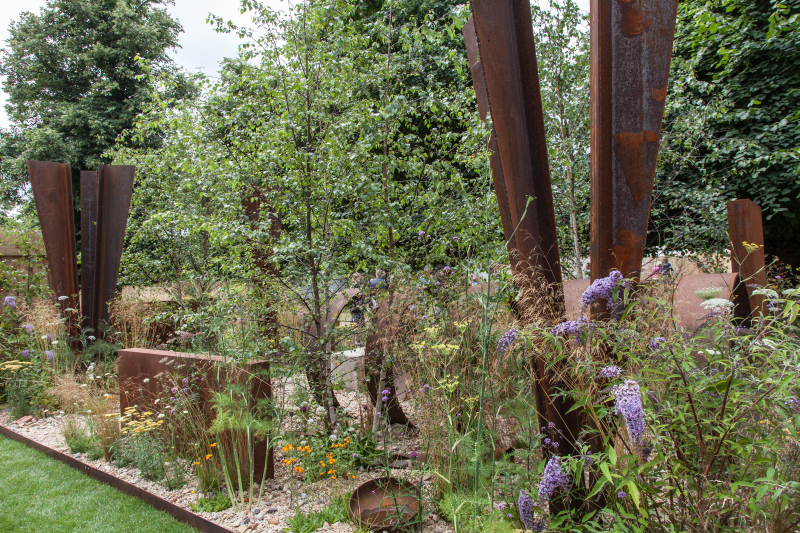
Tall folded sections rise above the grasses, their angled faces catching different amounts of light. Narrow gaps between them preserve glimpses of foliage, allowing the vertical forms to stand out without becoming a continuous wall.
Their reddish-brown surfaces echo the rings below, connecting pieces of different heights through color. Slender tree trunks provide a second set of vertical lines, but their branching crowns spread beyond the metal’s straight edges.
Fine Grasses Become Clear Against Solid Panels
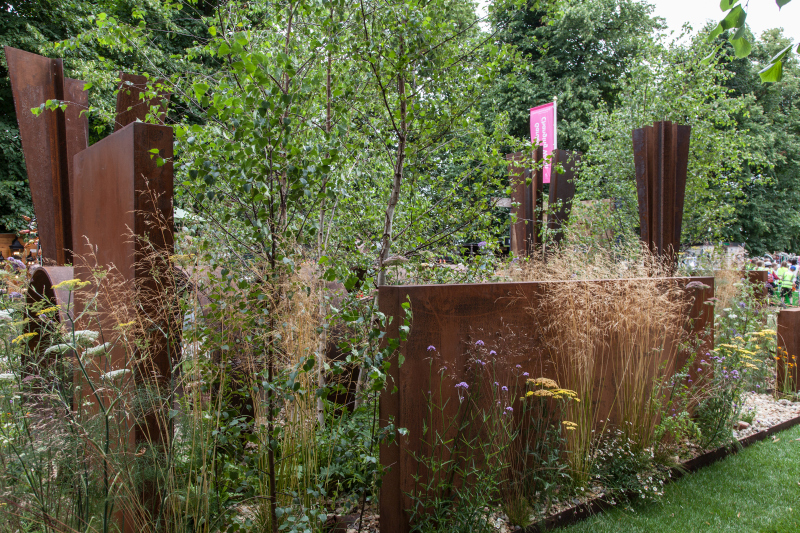
Pale seed heads can disappear against dense foliage, but the broad rust-colored panel gives them a backdrop. Individual stems and branching sprays remain visible across its face, turning a fine-textured plant into a feature.
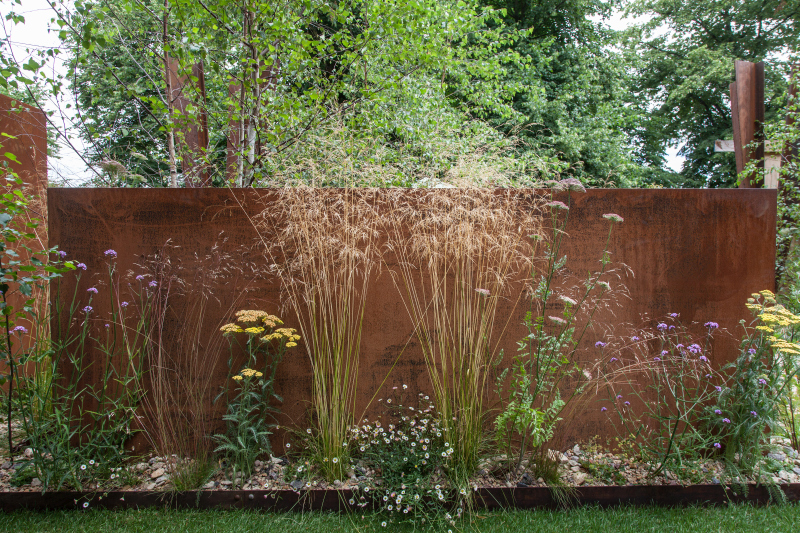
The panel stops below the tree canopy, leaving foliage visible above it. Along its base, yellow flower clusters, purple blooms, and small white daisies break up the straight boundary between metal and gravel.
Concrete Blocks Introduce a Different Kind of Weight
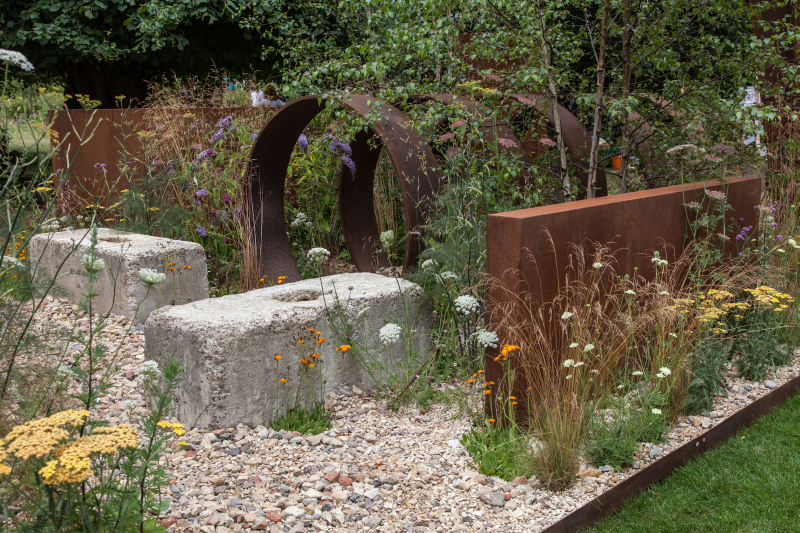
Rough pale blocks sit among the planting, with worn surfaces and irregular marks contrasting with the thin edges of the metal panels. Their low, horizontal forms keep the composition from relying on upright structures alone.
Open rings remain visible behind them, creating a change from solid foreground objects to see-through shapes farther back. Gravel fills the spaces around both, allowing small plants to emerge close to their bases.
A Shallow Bowl Brings the Detail Down to Ground Level
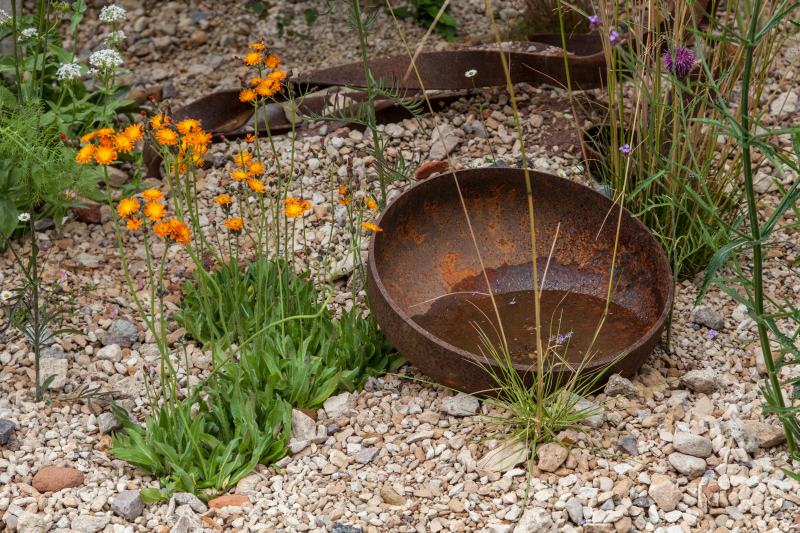
Water collects inside a rust-colored bowl tucked beside orange flowers and fine stems. Its curved rim repeats the circular forms elsewhere, but at a scale that rewards a closer look.
Set below the flower heads, the bowl adds a reflective surface among the dry textures of gravel and metal. Surrounding plants soften its placement without hiding the opening.
Small Wheel Rewards a Closer Look
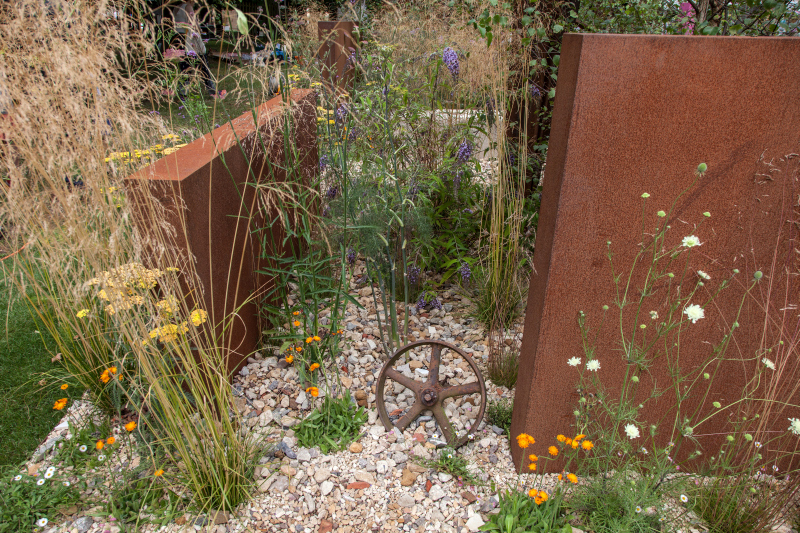
Between two broad panels, a spoked wheel rests near the ground, partly surrounded by stems. Its compact circle repeats the larger rings without competing for the same view.
The position creates a second discovery beneath the taller planting. A viewer drawn toward the panels can find the wheel after noticing the grasses and flowers around it.
Thin Metal Edge Keeps the Loose Planting Contained
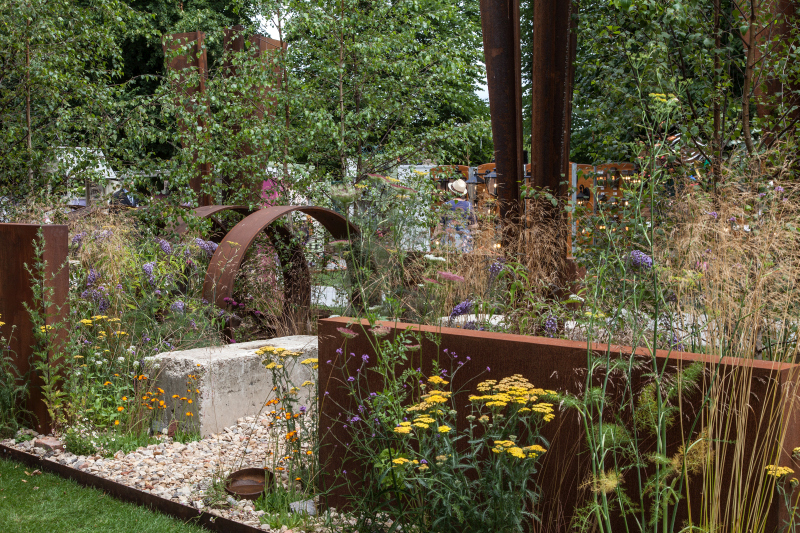
Along the lawn, a narrow metal strip draws a firm boundary around the gravel bed. Plants can lean across that line, but the change from grass to stone remains clear.
That restrained edge gives the larger sculptures room to dominate without adding another bulky border. Would one ring create enough interest in a backyard, or is the repeated sequence what makes the view worth exploring?