Mixing baking soda, salt and hot water in a foil-lined bowl: what’s it for, and why is it recommended?


You take the good silverware out of its box for the holidays and it’s covered in a brown-black film. You rub one fork with polish until your fingers turn gray, and the dark lines in the pattern are still there. The rest of the set is waiting.
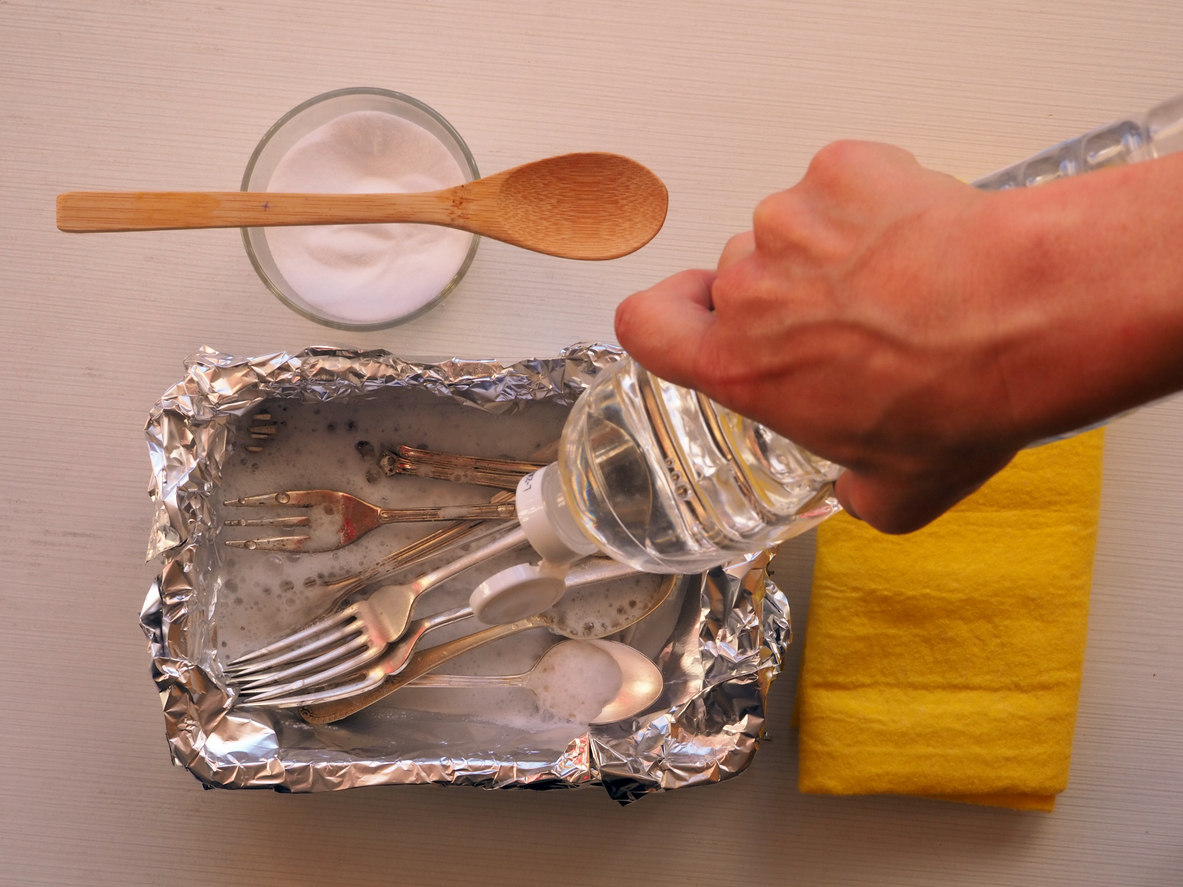
You aren’t rubbing the wrong way. The black film is tarnish, and the deepest part of it sits in grooves a cloth can’t reach. A bowl lined with aluminum foil, a little baking soda and salt, and very hot water can lift it chemically, without any scrubbing.
Why the foil does the work, not your elbow
Tarnish forms when silver reacts with sulfur compounds in the air, leaving a dark layer of silver sulfide on the surface. As materials scientist Jerome Kruger of Johns Hopkins University put it, “Tarnish doesn’t harm the metal. It’s just ugly.”
The foil turns the bowl into a small battery. A chemistry demonstration from the University of Wisconsin-Madison describes how an electrochemical cell forms between the silver sulfide and the aluminum, producing silver and aluminum sulfide. In plain terms, the sulfur leaves the silver and moves to the foil. The baking soda and salt mainly help the water carry the current.
That’s why it works so well on patterned pieces. Kruger noted that tarnish in the grooves is very hard to remove with commercial cleaners, while the bath reaches every crevice the water touches.
How to set up the foil bath
Use a heat-safe glass bowl, and keep the silver in contact with the foil:
- Line the bowl. Cover the bottom with a sheet of aluminum foil, shiny side up.
- Add the silver. Lay the pieces directly on the foil.
- Sprinkle the dry ingredients. Add 1 tablespoon of baking soda and 1 tablespoon of salt.
- Pour in very hot water. Use 2 to 4 cups, enough to cover the pieces completely.
- Wait 5 to 10 minutes. Then lift the pieces out, rinse them well in clean water and dry them with a soft cloth.
If a piece is still dark, repeat the bath once. For heavy tarnish, the Johns Hopkins method goes further: wrap the piece in foil with tight contact in at least one spot, cover it with water containing 4 to 5 tablespoons of baking soda per quart, and simmer gently for 30 minutes in a glass, enameled or stainless steel pot.
The bath may not bring back a mirror shine on broad, flat surfaces. A little commercial polish on those smooth areas finishes the job, and the hard part in the grooves is already done.
Polished silver doesn’t have to stay in the drawer between holidays. A silver serving tray can carry an easy table centerpiece made of three old mason jars of different sizes set on a doily, with flowers in the largest one.
Pieces to keep out of the bath
This works on solid silver and sterling silver. Skip silver-plated pieces, and keep jewelry set with pearls, opals, turquoise, coral, amber or emeralds out of the water entirely.
Handle the bowl with care, since the water is very hot, and let it cool before you pour it out. Rinse every piece well so no baking soda or salt dries on the surface.
If a piece has sentimental or collector value, or you aren’t sure what it’s made of, ask a jeweler or silversmith before you put it in.
A sheet of foil, two spoonfuls from the pantry and a kettle of hot water. That’s the trick.