Heat Left White Rings on Her Wood Table: She Used More Heat to Make Them Fade

Adding heat to a wood table covered in heat marks sounds like a way to make the damage worse. White rings had spread across this tabletop, but the treatment that reduced them involved another hot object placed over the finish.

An iron and a smooth towel became the tools for treating the secondhand dining table. Bought on Craigslist for $125 with its matching chairs, the set already had white marks when DeeDee of Clover House brought it home with plans to refinish the wood.
Seven years passed without that overhaul, while more marks appeared across the surface. A large circular ring prompted another round of treatment, which she documented to show what changed and where the method fell short.
White marks were part of the purchase

The previous owner cited the marks as the reason for selling the set, but the planned refinishing made them less of a concern for the buyer. Years of use added more pale patches across the tabletop, leaving damage that extended beyond one cup-sized ring.

The large circle stood out against the brown grain, with smaller cloudy areas scattered around it. According to the owner, hot dishes could leave marks even with pot holders beneath them, while the worn finish had become more prone to marking.
An iron supplied the heat through a towel

The tools were household items: an iron with a steam setting and an old kitchen towel worn smooth through washing. The cloth covered the marked area, keeping the iron’s soleplate away from direct contact with the tabletop.
A smooth cloth mattered because the owner wanted to avoid pressing a fabric texture into the finish. She filled the iron with distilled water and chose a medium setting for her demonstration.
Movement and checks were part of the treatment

With the towel over the ring, she moved the iron across the cloth instead of holding it over one spot, lifting the towel at intervals to inspect the surface. Her account describes using steam, making the treatment a contrast to the hot dishes she blamed for the marks.
This was her method on an old, worn finish, rather than proof that steam suits every wood table. Heat and moisture can also damage a finish, so the result should not be treated as a guarantee for another piece of furniture.
The largest ring disappeared from view

After treatment, the circular outline no longer stood out against the grain in this view. A separate pale patch remained near the board joint, showing that clearing one area did not remove the marks across the rest of the table.
Smaller patches received the same treatment

Another pair of photographs records the cloudy patches near the table’s edge before and after treatment. The brown surface becomes visible where those marks had interrupted the grain, without sanding away the surrounding finish.
Fewer marks did not mean a new finish

The wider view shows a clearer tabletop, but the owner still reported faint spots and a finish that needed replacement. She had used the method over the years and said it was becoming less effective as the coating wore thin.
That distinction gives the result its value: the treatment reduced visible marks while leaving the planned refinishing for another day.
The comparison shows what changed—and what did not
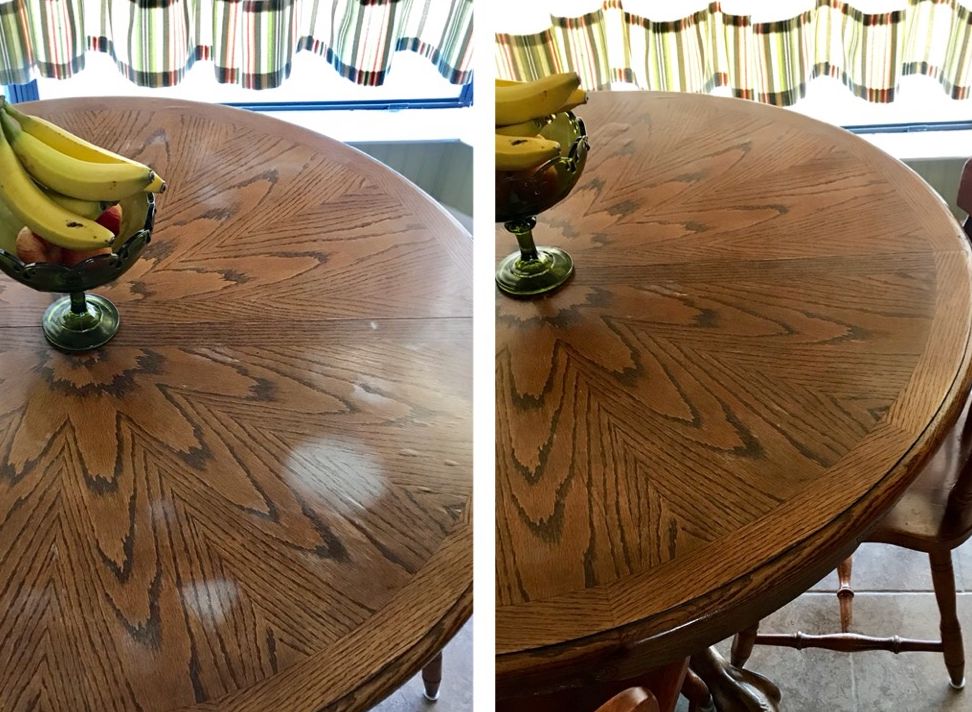
White patches cover much of the surface in the before photograph, while the after view brings the wood grain back into focus. The table retained its existing color and finish; the change came from reducing the pale marks rather than applying stain or a new coating.
Would you try a spot treatment on a marked tabletop, or would a worn finish make refinishing the better next step?
Images and project details: DeeDee, Clover House.